The history of the regional library dates back to the distant thirties…
On April 15, 1934, the Karaganda Regional Party Committee adopted a Resolution “On the Work of Libraries in the Region,” point 13 of which stated: “to propose to the regional education department (oblonoo) to reorganize the Petropavlovsk City Central Library into the Karaganda Regional Library no later than March 10, 1934, which would be tasked, in addition to serving the region, with directly providing books to the workers of Petropavlovsk… To propose to the city council to expedite the provision of the building occupied by the grain trust for the library, with the expectation of its opening no later than May 10…”
In 1936, due to the renaming of the region, the library became known as the North Kazakhstan Regional Library.
In March 1936, the library first acquired literature worth 13,000 rubles, allocated from the regional budget.
1937 — The library was allocated part of the premises in the left wing of the city council (now the regional historical and local lore museum). The reading room was on the first floor, and the lending department on the second.
1941 — The library was moved to a separate single-story building at 41 Lenin Street.
1949. The library staff consisted of 12 people. The following departments operated: lending, reading room, Kazakh language book lending, and book acquisition and processing.
1950. Courses for training rural librarians were opened at the regional library, operating for 30 years.
1959. A reference and bibliographic service was established, and the position of chief bibliographer was introduced.
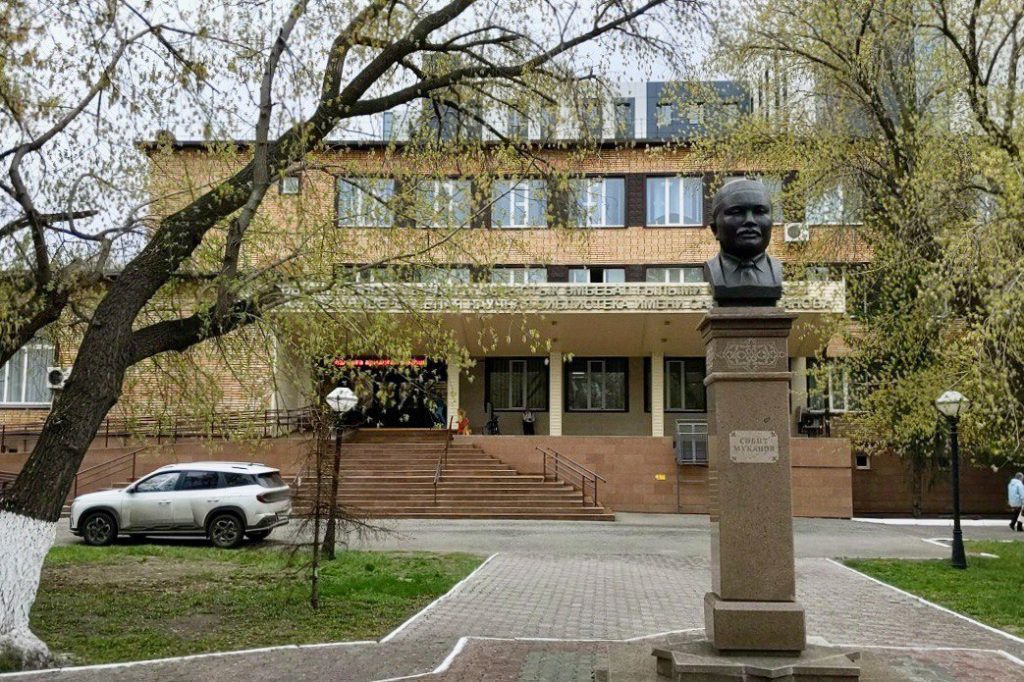
1968. With the direct participation of writer-academician Sabit Mukanov, the Supreme Soviet of the Kazakh SSR decided to construct a new building for the regional library.
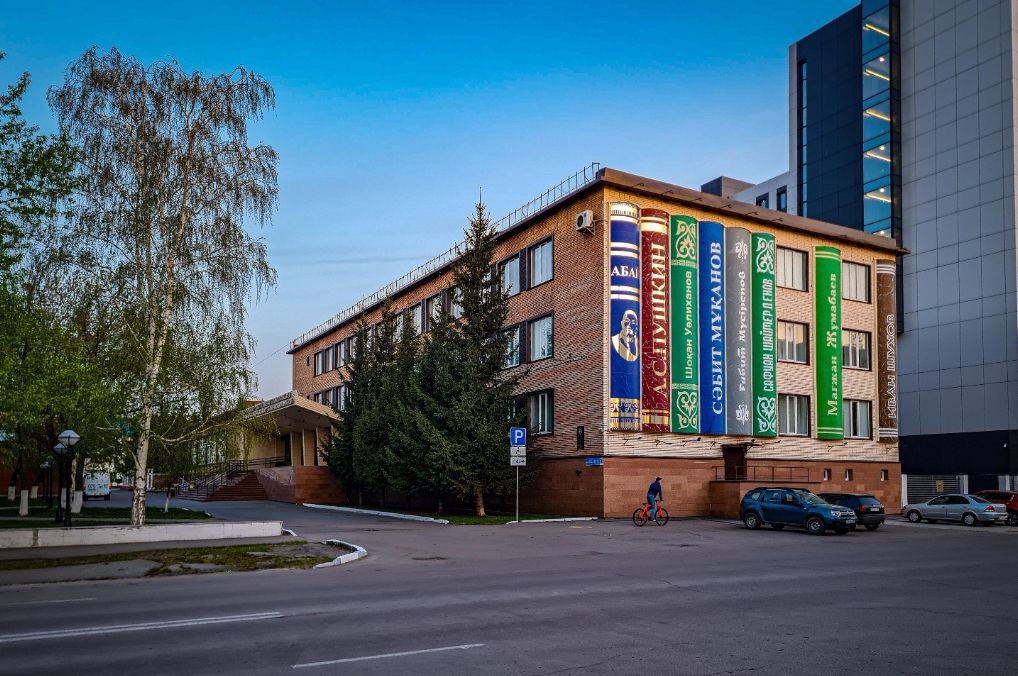
1973. The regional library moved into a new standard building with an area of 3.2 thousand m². New departments were formed within the library’s structure: book storage, agricultural specialists’ services, art literature, foreign language literature, interlibrary loan (ILL), and exchange-reserve fund.
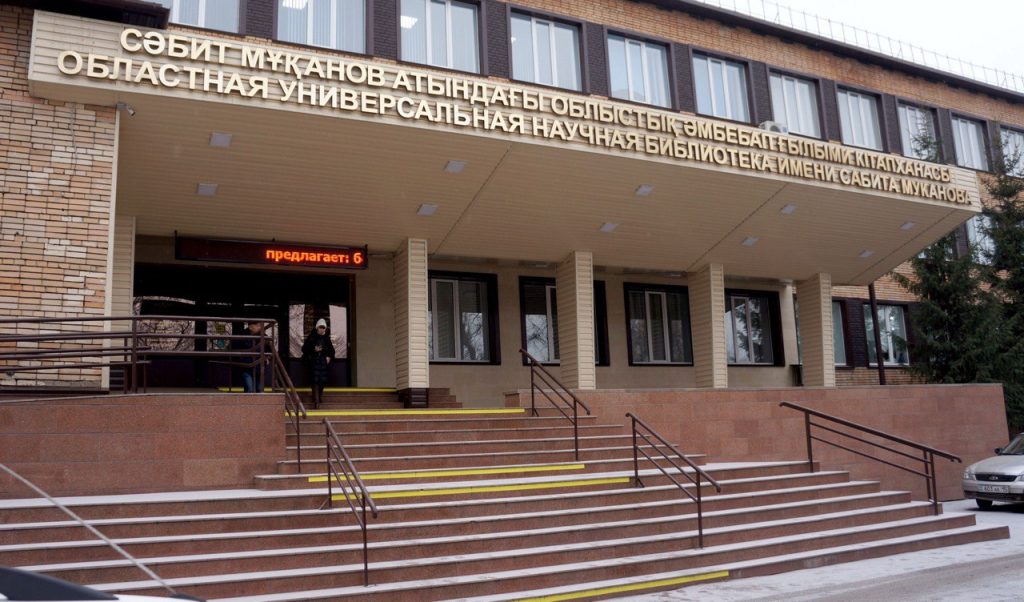
May 23, 1973. By Resolution of the Council of Ministers of the Kazakh SSR, the regional library was named after Sabit Mukanov.
Today, the Sabit Mukanov North Kazakhstan Regional Universal Scientific Library is the largest library in the region in terms of collections, volume, and accessibility of services, a center for local history and promoting reading, and a treasury of the best examples of national and world culture.
Priority Areas
In conditions of high demands for quality of life and standards for providing public services, the library strives to fulfill the main goal of its activities – improving library and information services for the population of the North Kazakhstan region.
1941 — The library was moved to a separate single-story building at 41 Lenin Street.
1949. The library staff consisted of 12 people. The following departments operated: lending, reading room, Kazakh language book lending, and book acquisition and processing.
1950. Courses for training rural librarians were opened at the regional library, operating for 30 years.
1959. A reference and bibliographic service was established, and the position of chief bibliographer was introduced.
1968. With the direct participation of writer-academician Sabit Mukanov, the Supreme Soviet of the Kazakh SSR decided to construct a new building for the regional library.
1973. The regional library moved into a new standard building with an area of 3.2 thousand m². New departments were formed within the library’s structure: book storage, agricultural specialists’ services, art literature, foreign language literature, interlibrary loan (ILL), and exchange-reserve fund.
May 23, 1973. By Resolution of the Council of Ministers of the Kazakh SSR, the regional library was named after Sabit Mukanov.
Today, the Sabit Mukanov North Kazakhstan Regional Universal Scientific Library is the largest library in the region in terms of collections, volume, and accessibility of services, a center for local history and promoting reading, and a treasury of the best examples of national and world culture.
Priority Areas
In conditions of high demands for quality of life and standards for providing public services, the library strives to fulfill the main goal of its activities – improving library and information services for the population of the North Kazakhstan region.
In this regard, special attention is paid to:
Improving the quality of library and information services for the region’s population by expanding the library’s service capabilities and enhancing the acquisition of information resources;
Creating conditions for cultural, educational, and leisure projects;
Comprehensive development of information technologies aimed at ensuring comfortable user experience;
Creating a regional library and information environment.
Integrating the library and information resources of the Regional Universal Scientific Library into the information and communication environment of Kazakhstan;
Library and information services for people with disabilities.
Collection
The main wealth of the library is its book collection, over 750,000 items, representing unique content and diverse types of collections.
A set of measures is carried out to preserve the collection: monitoring storage conditions in repositories; binding work; digitization of individual collections for their provision in full-text databases.
The Electronic Catalog and databases help to reveal the collection. Consolidated electronic information products are being prepared, bibliographic aids are published, and our own full-text electronic resource – “North Kazakhstan Electronic Library” – is being formed, featuring the most valuable local history documents.
User Services
Annually, over 300,000 people visit the library. The region’s population is served through the interlibrary loan system and electronic document delivery.
Readers have free access to all national and global information resources. Remote users are provided with various electronic services and resources on the library portal.
Special attention is paid to modernizing service processes. Services provided include: search, document ordering, and remote user registration.
The library actively interacts with users through social media channels: Facebook, VKontakte, Instagram, YouTube. The team does a lot to ensure that readers in the library or remote users promptly receive complete information according to their requests.
Issues of organizing an accessible environment: library and information services for people with disabilities are carried out according to a special plan.
The Sabit Mukanov North Kazakhstan Regional Universal Scientific Library is not only an information and educational center but also one of the favorite places for leisure, cultural, and spiritual communication for North Kazakhstan residents. Many are attracted by the opportunity to interact with people of similar cultural interests at meetings of various clubs: “Local Historian,” “Kalamger,” “Harmony,” the literary and poetic club “Proba Pera,” the Petropavlovsk Book Club, the English Language Club, the Literary Living Room, the “Open Book” Reading Center, courses for learning the Kazakh alphabet in Latin script, the “Makerspace” robotics resource center, 3D tours of Sacred Places, and others.
A Coworking Center has been created for youth, where they can communicate with friends and like-minded people, realize their creative abilities, organize business meetings, discussions, master classes, and training sessions.
All information about the library’s work is posted on the portal and in the media.
Projects
The library’s project activities have become fundamental in promoting books and reading, and in the technical and technological modernization of library work. There are 20 of them. Large-scale events of various forms and levels are held: from international, national, and interregional to city-wide. These include festivals, fairs, campaigns, and scientific and practical conferences. A youth project – Startup – is working to find a large-scale and successful business model.
Exhibition projects form a cultural and educational space. Each exhibition is accompanied by a series of meetings, presentations, master classes, and excursions using the information resources of the Sabit Mukanov North Kazakhstan Regional Universal Scientific Library. Such projects have received positive feedback from readers and city residents.
The S. Mukanov North Kazakhstan Regional Universal Scientific Library is an active participant in projects aimed at creating consolidated information resources of national significance: the Kazakhstan National Electronic Library, electronic document delivery (EDD), etc. Cooperation with major Kazakhstani and Russian libraries and participation in international cultural projects expand the information space for readers.
Methodological Center
The library’s activity as an organizational, methodological, and scientific center for 321 libraries in the region promotes professional cooperation and the adoption of innovative experience in the field of acquisition, processing, creation of corporate information resources, and the use of network technologies. The library initiates cultural programs, monitors the activities of rural libraries, prepares analytical reports on the state of library affairs in the region, and organizes scientific research on issues of library collection formation and increasing the reading level of the region’s population.
Great attention is paid to the library’s human resources. Thanks to their activities, projects such as “Living Book,” “Biblionight,” “Living Library,” “Book Giving,” and others are implemented.
Interaction with the Local Community
The North Kazakhstan Regional Universal Scientific Library strives to find public support for its development: new friends and partners appear annually. With their help, public and cultural events are held, and collections are replenished (gifts and donors).
Responding keenly to all ongoing changes in societal development, the North Kazakhstan Regional Scientific Library is constantly evolving, introducing new technologies, and effectively utilizing existing potential, which allows us to preserve the best cultural traditions.
We will be glad to see you within the walls of our library.
We are open to mutually beneficial cooperation and ready to consider your wishes.
To submit suggestions, leave your details below and click the “Send Data” button